
Story by ProvisionsMKY team
Video by Quinnen Taylor
Graphics by Justin Gaston
The ultimate destination for growing young athletes is to find themselves on the stage of a college institution.
“To whom much is given, much is expected,” Head Coach of Murray State women’s basketball, Rechelle Turner said.
It’s the light under the fire. It’s what encompasses each early morning practice and hard work. To become a college athlete.
A college athlete knows many names: student, athlete, student-athlete. Through the glorified position as a college athlete, the less glamorous side “student” gets ignored. For the student-athlete though, both parts can quickly become a drowning juggling act.
Sometimes the question may come about “what is life as a student athlete like”?
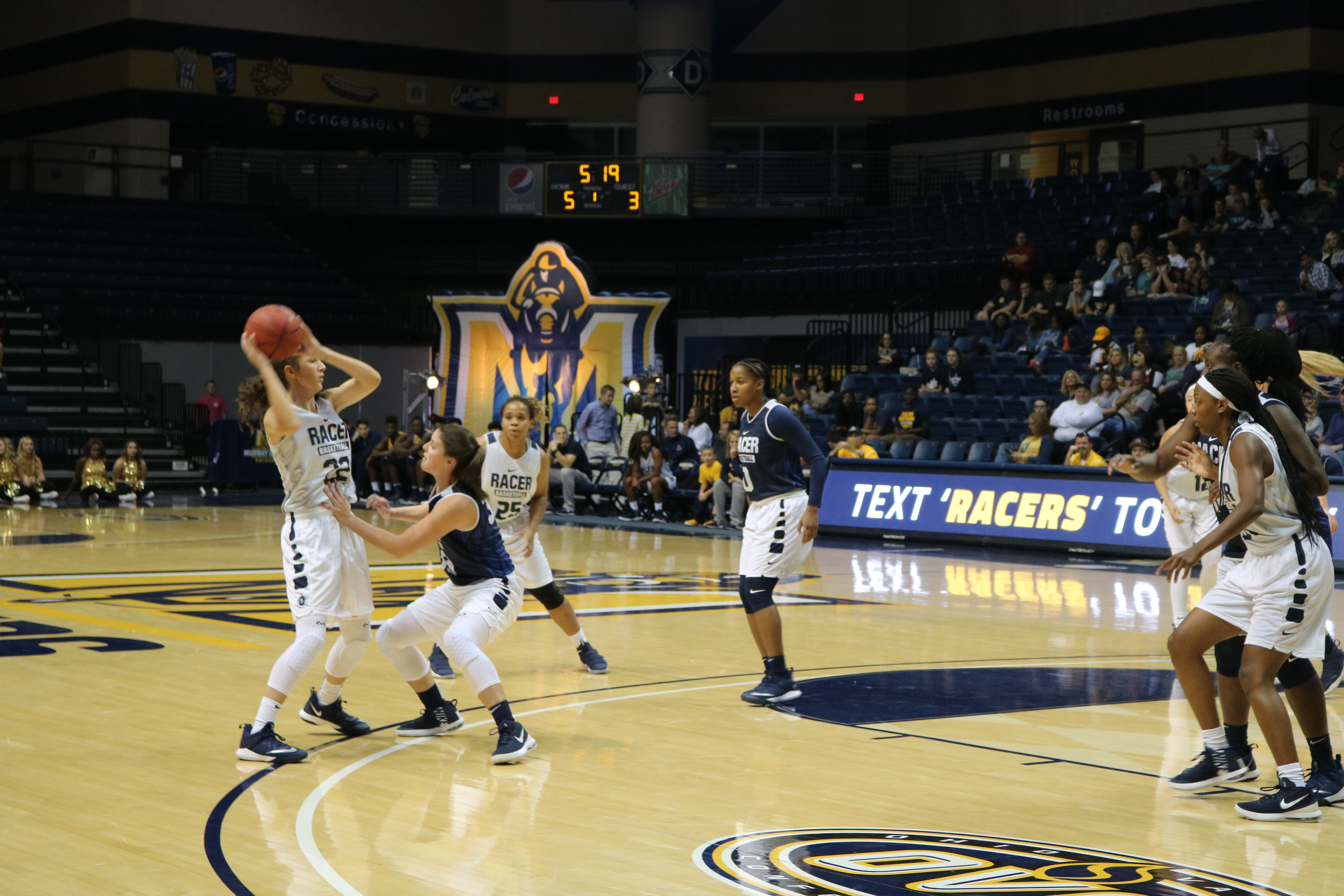
Behind the flashing lights and the glamour of game day, student-athletes juggle two things: preparing for games and studying their academics.
But what about the downtime for a student athlete? Do they go bowling with friends? Do they travel home to visit family? And if so, how do they afford it? These are some of the questions that come to mind when thinking of balancing the job of being a student athlete.
“The supports are there to help those players,” Turner said. “You have to determine how much is needed for academics, you know how much time is expected in athletics.”
Women’s Division I basketball receives full scholarships for every player on the team. For Murray State, there are 14 players on the women’s basketball team and all 14 received full scholarships to attend Murray State. Other women’s sports; soccer, cross-country, track and field, golf, rifle and softball, do not.
In 2015, the NCAA implemented the cost-of-attendance rule which means that players receive a certain monthly stipend based on the cost of living at the university.
The president of the National College Players Association, Ramogi Huma in an
interview with CNN, spoke on how this vote was “solid progress” for collegiate athletes in all sports.
“For the last 15 years the NCAA and the schools were screaming this would destroy us, we can’t afford it,” Huma said in the interview. “Now even the smallest schools have found a way to pay it.”
The stipend is designed for football and basketball players, but it can also be available to athletes in a “non revenue” sport such as cross country, soccer, baseball and volleyball.
According to ESPN.com, in 2016 the NCAA made a $2.1 billion profit on football and men’s basketball alone and will grow even more in 2017.
The stipends in total cost the NCAA $103 million last year. Stipends can range anywhere from $2,000 to $5,000 depending on the school cost of attendance and other “direct” cost that may occur.
These stipends mean more than just “spending money” for college athletes.
“In men’s basketball when they use those namesakes of those players in time to bring more people in and sell memorabilia and stuff like that,” Turner said. “Yeah I think at times that there may need to be some way, some how that they give back to those players.”
Turner fashions herself as old school though. She herself was a former division I athlete here at Murray State University and knows the battle of battling through college studies and athletics.
Acknowledging all the perks for the opportunity to play college basketball, “There’s a lot of perks to playing college basketball: the gear, the travel, the unlimited meals. There are so many perks that they get.”
Chase Darnell, a former Murray State athlete, returned home from University of Kentucky to be able to compete. When he returned to his hometown and Murray State, Darnell settled into an apartment off campus. In order to pay for living expenses, he got a job at Five Points, a local gas station.
The NCAA always a maximum of 12 scholarships per non-revenue sports (soccer, track and field, cross country, tennis) in division I with five being full-ride scholarships.
Darnell ran cross country for Murray State University from 2011-2013. At one point, Darnell had two jobs while competing as a Murray State athlete: working at the CFSB center and coaching track for Murray High and Murray Middle schools.
“It was almost impossible sometimes,” Darnell said. “Attempting to have a social life at the same time, it was very difficult.”
Darnell remembers sitting in his car and wondering how he was going to be able to pay his rent.
“I had almost no free time and I was working out of necessity so that I could pay my bills,” Darnell said. “If I had the option to not do that I wouldn’t have.”
College athletes have learned to juggle responsibilities throughout the year. They have adapted to the strenuous and demanding schedule set in front of them, perfecting their ability to juggle. Even though these athletes have learned how to overcome the objective of being a student athlete, the NCAA is forging the way to provide help. As the years turn the league does more and proposes more to balance out the work load landed on college athletes.